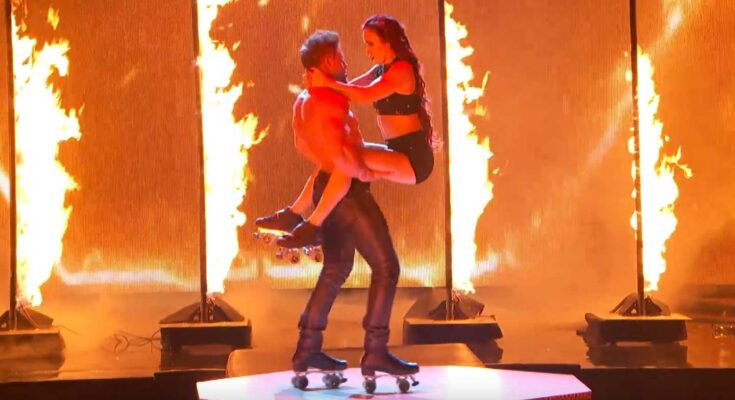
There is something uniquely thrilling about watching a danger act on a talent show. The performers appear fearless as they attempt breathtaking stunts involving heights, fire, sharp objects, speed, and seemingly impossible escapes. But when something goes wrong, the excitement can instantly turn into shock.
Danger acts are designed to create suspense. Performers carefully rehearse their routines, calculate timing, and rely on equipment and safety teams. Even with extensive preparation, however, live performances can produce unexpected moments.
One memorable example involved acrobatic duo Duo Transcend on America’s Got Talent. During a 2018 live performance, Mary Wolfe-Nielsen was performing a difficult trapeze routine with her husband, Tyce. Near the end of the act, she slipped from his grip and fell onto the stage. The audience and judges immediately reacted with alarm. Fortunately, she was able to get up and signal that she was okay.
The incident demonstrated just how quickly a seemingly perfect performance can change.
Another much more serious case involved daredevil Jonathan Goodwin during rehearsals for America’s Got Talent: Extreme in 2021. Goodwin was attempting an extremely dangerous escape stunt involving two suspended vehicles. The stunt went catastrophically wrong, leaving him with severe injuries.
Goodwin’s accident became a powerful reminder that these performances aren’t simply theatrical tricks. Behind the spectacular television moments are real people performing physically demanding and sometimes genuinely dangerous work.
There have been other startling moments in talent-show history. In 2016, sword swallower Ryan Stock was involved in a frightening mishap on America’s Got Talent when a flaming arrow fired during his routine struck him in the neck rather than hitting its intended target. Stock later said the incident resulted from a mechanical failure and that he was fortunate to walk away from it.
Moments like these can leave judges, contestants, and audiences frozen for a few seconds.
The difference between a successful danger act and an accident can sometimes come down to timing measured in fractions of a second. A grip can slip. A mechanism can malfunction. A performer can move unexpectedly. Equipment can behave differently from how it did during rehearsal.
That is why professional stunt work requires extensive preparation and safety planning. Industry safety guidance emphasizes careful choreography, rehearsals, competent stunt coordination, professional performers for high-risk work, and appropriate emergency procedures.
Yet danger acts continue to fascinate audiences because they combine skill and suspense in a way few other performances can match.
When a magician produces a card, the audience wonders how the trick works. When a singer hits a powerful note, viewers appreciate the talent. But when a performer hangs dozens of feet above the stage or attempts an escape while surrounded by dangerous objects, the audience experiences something different: genuine uncertainty about what will happen next.
That uncertainty is exactly what makes these acts so compelling—and so nerve-racking.
Fortunately, not every mistake ends in tragedy. Some performers walk away from frightening mishaps with little more than a scare. Others use the experience as an opportunity to rethink their routines and improve their safety procedures.
For viewers, the lesson is simple: what looks effortless on television may require years of training, planning, and preparation.
The next time a danger act appears on a talent show, pay attention not only to the spectacle but also to the incredible precision required to perform it.
Because when everything goes right, it can look like magic.
And when something goes wrong, everyone in the room suddenly remembers that the danger is very real.